
Review · KYOTO
Kyoto: Tea Ceremony with Maiko Premium
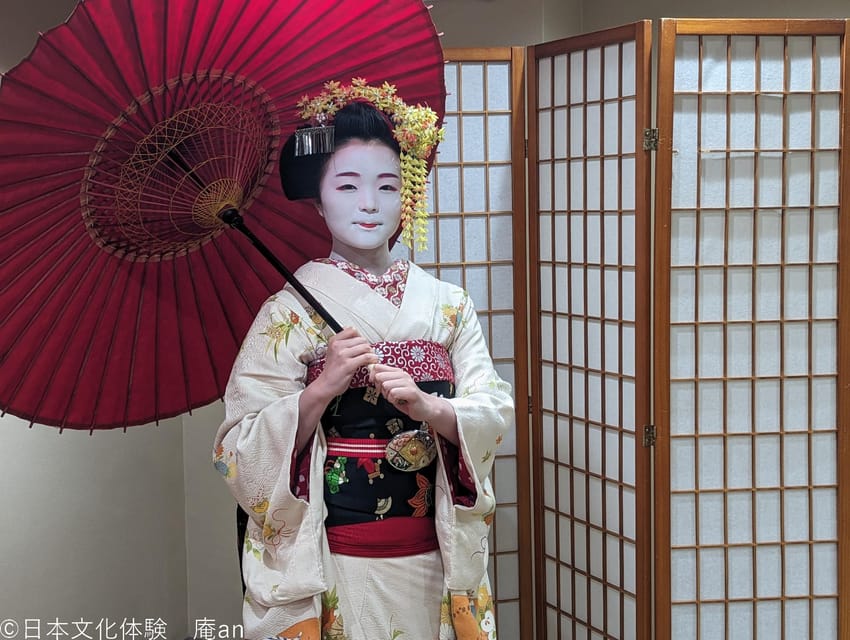
Kyoto’s maiko culture is usually glimpsed from a distance, so the chance to sit nearby, ask questions, and watch two traditional dances is the real draw here. You’ll also prepare your own matcha, receive two Japanese sweets, and take a photo beside the performer.
I like the direct question-and-answer time, which turns a pretty performance into a useful look at training and daily life. I also like the lively games, especially for families. The main drawback is the setting: this takes place in a modern building with tables, stools, and promotional signs, not in a traditional tea house.
- Meet a maiko up close, with a chance to ask about her training and routine.
- Make your own matcha and enjoy two dried Japanese sweets.
- Watch two traditional dances linked to seasons, stories, or daily life.
- Join a simple game, or sit back and cheer for the players.
- Take a commemorative photo and receive a senjafuda lucky charm.
- Pay attention to the seating choice, since first-row, second-row, and third-row upgrades cost extra.
Meeting a Maiko Near Gojo Station
This 90-minute experience begins just one minute from Exit 1 of Gojo Station on the Subway Karasuma Line. The entrance faces Gojo-dori, so you do not need to hunt through narrow lanes or search for a traditional tea-house doorway.
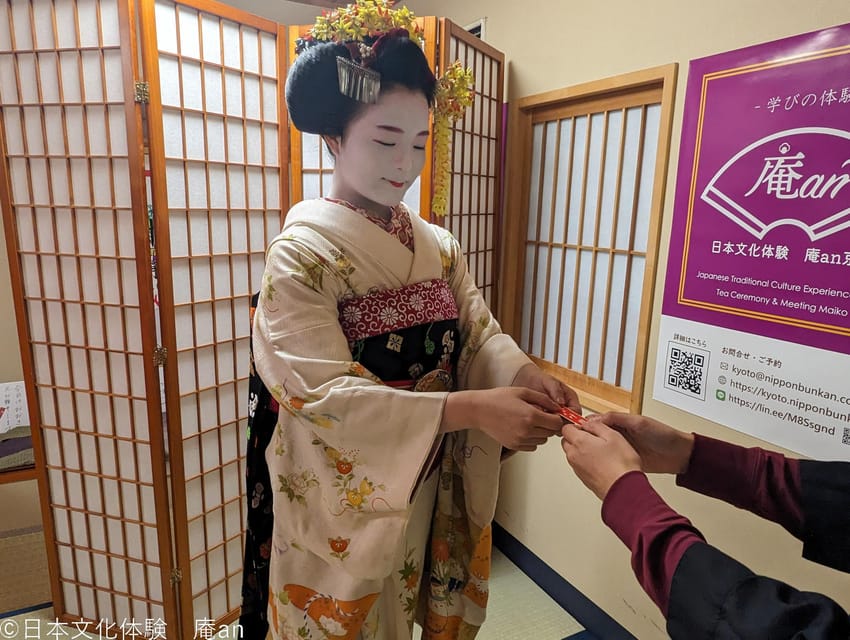
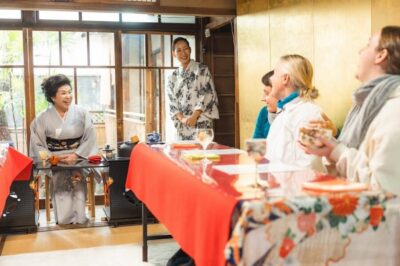
The location is practical, but it sets the tone. You walk into a building rather than an old Kyoto machiya or an ochaya, the traditional entertainment house where maiko and geiko perform. The room has tables and stools, and the backdrop may include large company advertisements and a QR code.
That plain setting is the one feature most likely to disappoint you if you are expecting a movie-like Kyoto scene. It can also affect photographs. You can still take pictures with the maiko, but the background may look more like an event venue than an old Japanese salon.
I would arrive early. The doors open in a modern building, and the experience does not wait for late arrivals. One useful tip is to allow a few extra minutes before and after the program if you want to see the maiko arrive or leave, though this is not part of the formal presentation.
There is no elevator, so you will need to use stairs to reach the venue. Keep that in mind if anyone in your party has trouble with stairs. The program is conducted in Japanese, with English translation provided as much as possible when requested in advance.
What the Premium Ticket Adds
The premium format is aimed at people who want more than a short tea demonstration. It combines matcha preparation, conversation, photography, two dances, and a game in one sitting.
At about $50 per person, the price is reasonable if you value direct contact and several different parts of Japanese performing culture. A shorter tea lesson alone would offer less time with the performer. Here, the maiko remains part of the program through the questions, photographs, dances, and game.
Seat upgrades cost extra:
- SS seat, first row: 3,300 yen
- S2 seat, second row: 2,200 yen
- S3 seat, third row: 1,100 yen
The standard price may be enough if you mainly want to hear the conversation and watch the dances. The first row is more useful if close photographs matter to you, but the added fee changes the value calculation. You already receive a photo opportunity as part of the program, so the upgrade is not essential for most people.
Children under two years old are free when sitting on a parent’s lap. If a separate seat or meal is needed, the regular one-person charge applies. The experience also includes snacks and a drink, although extra drinks inside may cost more.
More Tea Ceremonies in Kyoto
- Kyoto: Tea Ceremony in a Traditional Tea House in Kiyomizu
★ 4.9 · 3,519 reviews - Kyoto: Tea Ceremony Ju-An at Jotokuji Temple
★ 4.9 · 3,207 reviews - Kyoto: 45-Minute Tea Ceremony Lesson Experience
★ 4.3 · 2,378 reviews
Learning to Prepare Matcha
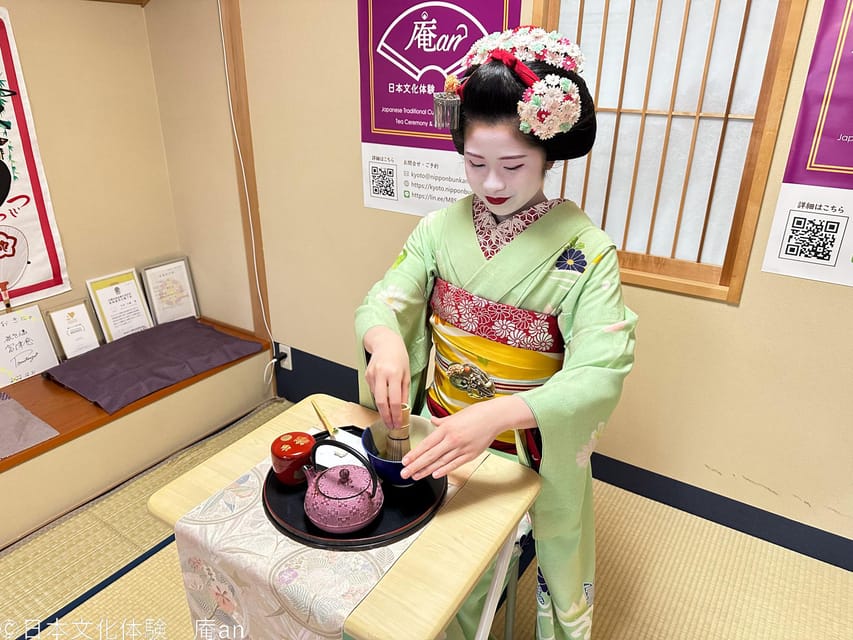
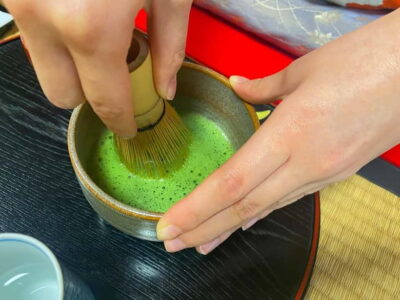
The tea portion begins with an explanation from the maiko. She shows you the basic method for making matcha, then you prepare your own bowl.
This is not a long, formal tea-school lesson. Think of it as a friendly introduction to the motions and meaning of matcha preparation. You will handle the whisk, follow the instructions, and taste the tea with two dried Japanese sweets.
That format works well for first-time visitors. You get to do something rather than simply watch a ceremony from a distance. The sweets soften the bitterness of the matcha and give you a small taste of the way tea and confectionery are paired in Japan.
If you have already taken a formal tea lesson, this part may feel basic. The value is less about mastering every movement and more about having a shared activity that opens the conversation with the maiko.
The tea ceremony is also a useful reminder that this is a cultural presentation, not a private tea-house appointment. You are there to learn, participate, and enjoy the exchange. The atmosphere is relaxed, and no special preparation or dress is required.
The Question-and-Answer Session
For many people, this is the most rewarding part. Instead of seeing a maiko only as a beautifully dressed performer, you can ask about her life, training, customs, and daily routine.
Maiko represent a living tradition. Their elaborate kimono, hairstyles, makeup, and disciplined training are not merely costumes for a stage show. The conversation helps explain the person behind the appearance.
Questions are taken from the group, so the exact discussion depends on the audience. You may hear about the path toward becoming a geiko, the demands of training, or the rules and routines that shape daily life. One point discussed in the program is that training can take years, with five years mentioned as part of the route toward becoming a geiko.
The quality of this section depends partly on translation. Japanese is the main language, and English help is available as much as possible. Some sessions have a host who works in both languages, while other sessions may use a translator. If clear English conversation is important to you, contact the provider before booking.
The group format also matters. This is not an intimate private meeting. You may share the room with people having lunch or dinner, and other participants may ask questions you had planned to ask. Still, the session gives you a rare chance to hear about the tradition directly rather than relying only on museum displays or guidebook notes.
Photographing the Maiko and Receiving a Senjafuda
You will have a chance to take a commemorative photo beside the maiko. This is one of the program’s most appealing features, especially if you want a clear memory of the meeting rather than only photographs from across a street.
Photography is also permitted during parts of the presentation, including the dances, although you should follow the host’s instructions. If you want the best personal photograph, use the available photo opportunity rather than relying only on pictures taken from your seat.
The backdrop is the weak point. Promotional material and a QR code may appear behind the performer, so your photographs may not have the traditional Japanese feel you imagined. The maiko’s kimono and styling remain the focus, but the room itself is plainly commercial.
You also receive a senjafuda, a small paper name card or lucky charm traditionally associated with performers. It is a thoughtful keepsake and gives you something tangible to take home besides a phone full of photographs.
Same leaf, a different ritual:
- Kyoto: Table-Style Tea Ceremony at a Kyo-Machiya
★ 4.9 · 1,211 reviews - Kimono Tea Ceremony at Kyoto Maikoya, NISHIKI
★ 5.0 · 911 reviews - Arashiyama Bamboo, Temple, Monkeys, or Secret Sake Brewery
★ 4.8 · 886 reviews - Kyoto: Arashiyama Bamboo Forest, Monkeys, Matcha & Temple Tour
★ 5.0 · 759 reviews
Two Dances, Performed Close Up
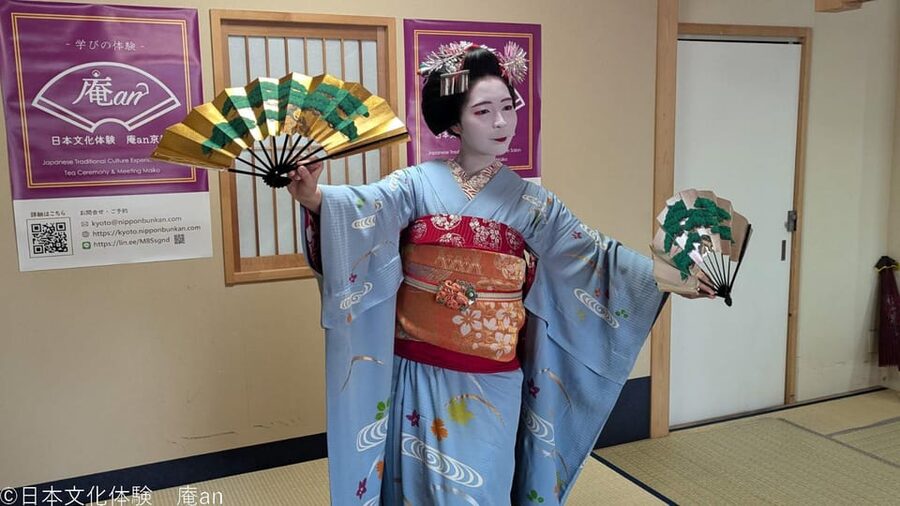
The dance portion is the visual heart of the program. The maiko performs two traditional dances, with movements connected to the seasons, love stories, or ordinary life.
The dances are not long stage productions. Their power comes from small gestures, precise posture, controlled steps, and the details of the kimono and sleeves. From nearby seating, you can pay attention to the hands, fan work, facial expression, and careful timing.
This is where the difference between seeing a maiko in passing and watching a trained performer becomes clear. The clothing may catch your eye first, but the discipline is in the movement. Even a short dance can feel concentrated and formal.
The room does not provide a grand theatrical setting. You will not be sitting in a richly decorated historic hall. Yet the plain surroundings can make the performer’s control more noticeable. The two dances are among the best reasons to choose the premium version instead of a simpler tea-only option.
If photographs are important, ask about the rules before the performance begins. You may be able to take photos or video, but you should avoid letting a phone screen block the view of people behind you.
A Traditional Game With the Maiko
After the dances, the mood becomes lighter. The maiko leads a simple traditional game, and volunteers may take part while everyone else claps and watches.
This section gives the program its social spark. The tea preparation is calm, the questions are thoughtful, and the dances are formal. The game breaks that pattern and lets the maiko interact with the group in a more playful way.
You do not need to volunteer. Watching is part of the fun, and the host encourages the room to cheer for the players. Children often enjoy this part because it has clear rules and direct interaction without requiring them to understand every detail of the tea ceremony.
The game also makes this a good choice for families. Children as young as four have enjoyed the mix of demonstration, questions, photographs, and play, though younger children may find a 90-minute seated program harder to follow.
A Geiko May Appear Instead
The title focuses on a maiko, but the performer may sometimes be a geiko. In Kyoto, a maiko is an apprentice in the traditional entertainment world, while a geiko is a fully trained performer.
That change does not mean the program is cancelled or reduced. You still receive the tea activity, question time, photograph, dances, and game. The conversation may offer a different perspective because a geiko has completed more of the training path.
If meeting specifically a maiko is your main reason for booking, understand that the performer is not guaranteed. If you are interested in Kyoto’s traditional arts more broadly, a geiko appearance can be a welcome surprise.
Timing, Group Size, and Atmosphere
The published schedule runs from the opening greeting to room departure in about 90 minutes:
- Greeting from the maiko
- Matcha preparation with two Japanese sweets
- Question-and-answer session
- Photo opportunity
- Senjafuda presentation
- Two dances
- Traditional game
- Departure of the maiko
- Additional chatting time
The formal program may feel shorter on some days. One account placed the main experience closer to 70 minutes, so I would treat 90 minutes as the planned booking length rather than a promise that every part will use the full amount.
The room can include a fairly large group, but the format is designed to keep the activities moving. It does not have the quiet privacy of a small tea lesson. Noise from other people can affect the dances or question time, so this experience suits you if you are comfortable sharing a cultural presentation.
The possible lunch or dinner setting is another practical detail. Depending on the arrangement, the program may take place with people eating nearby. That can make the atmosphere feel less ceremonial, but it also reinforces the relaxed, accessible nature of the event.
Is This Good Value at About $50?
I see the price as fair for a first visit to Kyoto’s maiko culture. You receive several distinct elements in one compact program: tea preparation, sweets, conversation, photographs, a souvenir, two dances, and a game.
The strongest value comes from the direct access. A dance performance alone would show you the finished art, but the question session explains the work behind it. The game and photo also make the encounter more personal than a standard stage show.
The price is less appealing if your priority is architectural atmosphere or a formal tea ceremony. The modern venue, advertising backdrop, group seating, and basic matcha lesson may not satisfy someone seeking an old-house setting.
For that reason, I would not book this expecting an untouched glimpse into a private ochaya. Book it as a well-organized introduction to maiko and geiko culture, with enough conversation and activity to keep the 90 minutes varied.
Who Should Book This Kyoto Experience?
I would recommend it to first-time visitors who want a clear, structured meeting with a maiko or geiko. It is especially suitable if you want to ask questions, take a photo, and see traditional dance without committing to a long evening of formal dining.
Families should consider it because the game adds movement and humor to the program. Children can also prepare matcha and receive sweets, though parents should remember that the room uses stairs and that a quiet seated program may not suit every toddler.
It also works well for couples and solo visitors who want a cultural activity close to central Kyoto. Gojo Station makes it easy to reach, and the 90-minute length leaves room for dinner or another evening plan.
You may want to skip it if you need a traditional tatami room, a private group, or guaranteed English conversation. You may also prefer another experience if your main goal is a full formal tea ceremony rather than a mixed program of tea, dance, questions, and games.
Final Verdict: Book It for Access, Not Atmosphere
I would book the premium experience if your priority is meeting a maiko or geiko at close range and learning directly about the tradition. The strongest parts are the question session, two dances, photo opportunity, and cheerful game. Those pieces give the program more substance than a simple costumed photo stop.
Go in with realistic expectations about the room. It is a modern venue, not a historic tea house, and the advertising backdrop can spoil an otherwise lovely photograph. If you can accept that tradeoff, the program offers a practical and enjoyable way to encounter an important part of Kyoto culture in a short period.
FAQ
How long does the Kyoto maiko tea ceremony last?
The scheduled duration is 90 minutes, including the tea activity, questions, photographs, dances, game, and departure. The main presentation may finish earlier on some days.
How much does the experience cost?
The listed price is $50 per person. Optional seating upgrades cost 3,300 yen for the first row, 2,200 yen for the second row, and 1,100 yen for the third row.
Is the performer always a maiko?
No. Depending on the circumstances, a geiko may appear instead of a maiko.
Is the tea ceremony held in a traditional Japanese house?
No. The venue is in a building and is not an ochaya or traditional Japanese house. It has a relaxed atmosphere with tables and stools.
Can I take a photo with the maiko?
Yes. The program includes a commemorative photo opportunity beside the maiko or geiko.
What is a senjafuda?
A senjafuda is a small paper name card or lucky charm presented to you as a special gift during the program.
Are food and drinks included?
The experience includes two dried Japanese sweets, matcha, snacks, and a drink. Additional drinks may be available for purchase at an extra cost.
Is English available?
Japanese is the main language. English translation is provided as much as possible if you request it, so contact the provider before the experience if translation is important to you.
Is the venue accessible by elevator?
No. The building has no elevator, and you need to use stairs to reach the venue.
Where is the meeting point?
The venue is a one-minute walk from Exit 1 of Gojo Station on the Subway Karasuma Line. The entrance faces Gojo-dori.
Can children attend?
Yes. Children under two years old are free when sitting on a parent’s lap. If a separate seat or meal is needed, the regular one-person fee applies.
Newly steeped around Kyoto
- Whisk Your Own Matcha: A Zen Matcha Experience at Temple★ 3.6 · 7 reviews
- Kyoto: Authentic Tea Ceremony in a Small Group★ 5.0 · 7 reviews
- Tea ceremony at Kyoto’s Zen Temple Teahouse★ 5.0 · 2 reviews
- Uji Walking Tour – Byodo-in temple and Tea Ceremony from Kyoto★ 3.5 · 3 reviews
- Tea Ceremony Experience in Traditional Kyoto Townhouse★ 5.0 · 19 reviews
- Tea Ceremony in 150 Years Old Townhouse with Tables and Chairs★ 5.0 · 22 reviews
- Sencha-do the Japanese Tea Ceremony Workshop in Kyoto★ 5.0 · 21 reviews
- Silent Beauty of Kyoto Zen Walk and Tea Experience★ 5.0 · 2 reviews
Tea Ceremony Experiences, compared.
Kyoto: Tea Ceremony in a Traditional Tea House in Kiyomizu
Read our review →
Kyoto: 45-Minute Tea Ceremony Lesson Experience
Read our review →
Kyoto: Table-Style Tea Ceremony at a Kyo-Machiya
Read our review →


Browse the lists this tea experience appears in