
Review · BEIJING
Private Beijing Spiritual Tour with Lunch and Tea Ceremony
Beijing’s spiritual life comes into focus on this private tour of three very different temples. You move from Buddhist devotion at Lama Temple to Confucian teaching and then Taoist tradition at White Cloud Temple, with a Chinese lunch and tea ceremony tying the day together.
I like the private vehicle and hotel pickup, especially in a city where crossing town can take time. I also like the clear theme: this is not just a parade of old buildings. Your guide explains how Buddhism, Confucianism, and Taoism shaped Chinese society.
The main drawback is the pace. You have about an hour at the first two temples, and the tea ceremony may feel short if you want a long, relaxed tasting. The tour works best when you arrive ready to listen, walk, and keep moving.
Key points at a glance
- Three faiths in one morning: Compare Buddhist, Confucian, and Taoist traditions at three major Beijing sites.
- The 18-meter Maitreya Buddha: Lama Temple’s giant statue is the visual centerpiece of the first visit.
- A five-minute temple walk: Confucius Temple and the Guozijian Museum follow Lama Temple without another vehicle transfer.
- Lunch at a local Chinese restaurant: The meal is included, and you can share dietary needs when booking.
- A private tea ceremony: Sample Chinese tea such as jasmine, oolong, or Green Dragon tea.
- A guide-led experience: Ramon is named in one account as an especially clear Spanish-speaking guide, though guide assignment can vary.
Three traditions, one Beijing day
This tour gives you a useful way to read Beijing. Buddhism, Confucianism, and Taoism are often discussed separately, but daily Chinese life has long drawn from all three. Your guide helps connect the statues, halls, rituals, and ideas instead of treating each temple as an isolated photo stop.
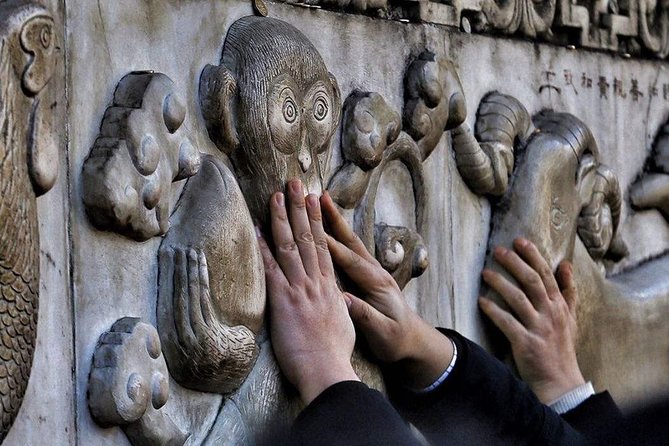
That approach matters because the buildings can look similar at first glance. Each has courtyards, carved details, incense, and religious objects, yet the purpose and mood change from place to place. Buddhism centers the Lama Temple visit, Confucian learning shapes the next stop, and Taoist practice guides the White Cloud Temple portion.
You also get a private setting rather than a fixed group. Your guide and driver meet you at your hotel at 9:00 a.m., and only your party takes part. That makes it easier to ask questions, request clarification, or spend a little more time on an object that catches your attention, though the overall schedule still has a set rhythm.
One useful detail comes from the guide service itself. Ramon is specifically praised for clear explanations in Spanish, careful time management, and patience with questions. If you need a Spanish-language tour, ask at booking whether Ramon will lead your departure. The supplied details do not promise a particular guide for every date.
More Tea Ceremonies in China
- Traditional Chinese Tea Ceremony Experience
★ 4.7 · 74 reviews - Beijing Culture: Tea Ceremony, Heritage Instrument & Calligraphy
★ 5.0 · 57 reviews - Chinese Tea ceremony in Beijing Hutong courtyard
★ 4.7 · 26 reviews
Lama Temple and the 18-meter Maitreya Buddha
Your first stop is Yonghegong, usually called Lama Temple, after a drive of about 20 minutes. It is one of Beijing’s best-known monasteries, and the visit begins with five ornate halls filled with colorful carvings, sacred objects, and detailed murals.
The one object you should keep in mind is the 18-meter Maitreya Buddha. The statue rises far above ground level and gives the visit a strong focal point. Your guide explains its religious and cultural meaning, which is more useful than simply walking through and taking a picture.
Allow about one hour here. That is enough for a guided introduction to the main halls, but not enough for a slow study of every carving and relic. If you like temple architecture, stay close to your guide and ask which details matter most. A short visit with context can be more rewarding than a longer visit where you are left to guess what you are seeing.
The atmosphere also shifts indoors and outdoors as you move through the complex. The halls contain the main sacred objects, while the courtyards help you see how the temple is arranged. The tour description emphasizes the colorful decoration and religious art, so expect a visually full first stop rather than a bare or minimal sanctuary.
Admission is included, and your guide handles the visit within the private tour schedule. Since the morning starts at 9:00 a.m., you do not have to arrange your own transport to the temple or work out the entrance details independently.
Confucius Temple and Guozijian in five minutes
From Lama Temple, you walk for about five minutes to the Temple of Confucius and Guozijian Museum. This short connection is one of the day’s practical strengths. You avoid another ride and get a brief look at the local streets between two historic sites.
The Confucius Temple is described as a quieter place away from Beijing’s crowded streets. Its restored main hall contains a statue of Kongzi, the Chinese name for Confucius, whose teachings shaped education, family duties, government, and social conduct across China.
This is the stop where the guide’s explanation matters most. Confucianism is not presented only as a religion in the same sense as Buddhism or Taoism. It is also a system of ethics and learning, and the temple setting helps you understand why respect for teachers, study, and orderly society became such lasting themes.
The temple is the second largest Confucian temple in China, after the one in Qufu, Confucius’ hometown. That gives the site national importance without making the visit feel as grand or visually crowded as Lama Temple. You have about an hour here, including time for the museum and the main hall.
I would pay attention to the contrast between the first two stops. Lama Temple offers large religious images and ornate halls. Confucius Temple feels more restrained and tied to education and public life. The tour is at its best when your guide makes that difference clear.
Lunch before the White Cloud Temple
After the first two temple visits, you stop for lunch at a Chinese local restaurant. Lunch is included in the price, and the description makes clear that it is a Chinese-style meal rather than a generic international option.
You should tell the operator about dietary requirements when you book. The available information does not provide a fixed menu, so it is sensible to ask questions early if you have allergies, restrictions, or strong food preferences.
The meal also adds a personal note to the day. One account describes enjoying food connected with the guide’s youth, which is the kind of detail that can make a meal feel more connected to place. You should not expect a formal cooking class or a long food tour. The value is simpler: you get a local-style lunch without having to stop the tour and choose a restaurant yourself.
Lunch is placed before the drive to White Cloud Temple, which is roughly 30 minutes away. That break gives you time to sit down after the walking at the first two sites. Since the entire experience lasts about six to seven hours, the meal is also a useful pause before the afternoon portion.
More Tea Ceremonies in Beijing:
- Beijing Culture Event: Tradition Music, Tea Ceremony, Calligraphy
★ 5.0 · 11 reviews - Beijing: Temple Of Heaven+Tai Chi Class+Tea Ceremony
★ 5.0 · 8 reviews - Traditional Chinese Tea Ceremony Experience
★ 5.0 · 7 reviews - Beijing Tai Chi and Tea Ceremony Experience
★ 5.0 · 4 reviews
White Cloud Temple and Beijing’s Taoist tradition
After lunch, you continue to Baiyun Taoist Temple, or White Cloud Temple. It was once one of China’s most influential Taoist temples and is one of the Three Great Ancestral Courts of the Complete Perfection School of Taoism.
Those titles can sound abstract, so this is another place where a guide adds real value. Your guide introduces the temple as the First Temple under Heaven and explains its place in Taoist history. The tour information does not promise a particular ritual or ceremony inside the temple, so expect a history and cultural visit rather than a chance to join religious practice.
You have roughly two hours for the White Cloud Temple portion, including the tea house visit afterward. That gives this final section more room than either of the morning temples. It is a good balance because you have already seen two sites and may want a less hurried pace by the afternoon.
Look for the change in emphasis. Buddhism at Lama Temple is represented through sacred halls and a towering Buddha. Confucianism at the second stop is tied to the sage Kongzi, learning, and social values. White Cloud Temple brings Taoist ideas and institutions into the picture. You are not asked to choose one tradition. Instead, you get a basic framework for understanding how all three have influenced China.
Admission is included here as well. The private vehicle remains part of the plan, and bottled water is provided.
Tea ceremony with jasmine, oolong, or Green Dragon tea
The tour finishes at a traditional tea house, where you take part in a tea ceremony and taste Chinese tea. Possible teas include Green Dragon, jasmine, and oolong.
This is more than a drink stop. Tea preparation is one of China’s long-running cultural traditions, and the ceremony gives you a calm final chapter after the temple visits. It also lets you experience a cultural practice through sight, smell, and taste rather than only through a guide’s explanation.
Keep your expectations measured. The tea ceremony may be brief, and one account found it rushed. If you want a long demonstration with extensive discussion of leaves, brewing temperatures, and regional styles, this tour may not provide enough time. If you want a compact introduction that fits naturally into a half-day excursion, it makes sense.
You can use this portion to ask your guide to connect tea with the themes of the day. The available details do not specify the tea house name, the exact tea served, or how long the ceremony lasts. Those details can vary, so ask if they matter to your decision.
Private transport and the value of $188
At $188 per person, this is not a bargain-priced temple outing. The value comes from having a private guide, a private air-conditioned vehicle, hotel pickup and drop-off, entrance fees, bottled water, lunch, and afternoon tea bundled together.
For a solo participant or a couple, the cost may feel high compared with using public transport and buying separate admission. But doing the day independently would require planning several stops, handling traffic and directions, arranging lunch, and finding your own way to a tea house. The private format buys convenience and explanation, not just transport.
The price can make more sense for a small group, especially since group discounts are offered. You should compare the final per-person rate with the number of people in your party before booking. The tour is also useful if you have limited time in Beijing and want the day organized around a clear subject.
The climate-controlled vehicle is particularly helpful for a six to seven-hour schedule. You are not carrying the full burden of city transfers, and the driver takes you back to your hotel after the tea visit. The first two sites are close enough to walk between, while the ride to White Cloud Temple is about 30 minutes.
Who will get the most from this tour
I would choose this experience if you want cultural context more than a checklist of famous sights. It suits you if you are curious about how different traditions shaped Chinese society and prefer a guide who can answer questions as you go.
It is also a good fit for visitors who want a private day with a simple structure. You start at 9:00 a.m., visit two nearby temples on foot, stop for lunch, ride to White Cloud Temple, take tea, and return to your hotel.
Families can take part, but children must be accompanied by an adult. Most people can participate, though you should consider the walking between halls and the six to seven-hour duration when deciding if it fits your group.
You may want another option if your main goal is extensive free time for photography, a long tea tasting, or a highly flexible schedule. The morning visits are about one hour each, and the tea portion can feel rushed. This is a guided cultural overview, not an unstructured day for lingering.
Should you book this Beijing temple tour?
Book it if you want three major spiritual traditions explained in one private outing, with transport, admission, lunch, and tea handled for you. The strongest part is the contrast between the sites, especially when your guide connects the Buddhist, Confucian, and Taoist stops to everyday Chinese culture.
The tour is also a sensible choice for a small group that values comfort and a local-style meal. Ask about the assigned guide, confirm any dietary needs, and check the tea ceremony timing if that is a major reason for booking.
Skip it if you want a slow, highly specialized religious study or a long formal tea session. For most visitors with one free day and an interest in Beijing beyond imperial palaces, this offers a focused and practical introduction.
FAQ
What time does the tour begin?
The tour begins at 9:00 a.m. Your private guide and driver meet you in your hotel lobby.
How long does the experience last?
The full tour lasts approximately six to seven hours, including the temple visits, lunch, tea ceremony, and return transfer.
Are hotel pickup and drop-off included?
Yes. Hotel pickup and drop-off are included, with transport provided in a private air-conditioned vehicle.
What is included in the price?
The price includes a professional guide, private transportation, bottled water, entrance fees, lunch at a Chinese local restaurant, and afternoon tea.
Can children join the tour?
Yes, but children must be accompanied by an adult. Most people can participate in the activity.
Can I share dietary requirements?
Yes. You should advise the operator of any specific dietary requirements when booking.
Newly steeped around Beijing
- Private Tour to the Temple of Heaven and Tea tasting at the Maliandao Tea city★ 5.0 · 3 reviews
- Temple of Heaven Private Tour and Tea Tasting at Maliandao Tea Street★ 5.0 · 2 reviews
- Traditional Chinese Tea Ceremony Experience★ 5.0 · 7 reviews
- Beijing Tai Chi and Tea Ceremony Experience★ 5.0 · 4 reviews
- 3-Hour Private Hutong Walking Tour with Drum Show at Drum Tower and Tea Tasting★ 5.0 · 3 reviews
- 3-hour Morning/Afternoon Tea Tasting on Maliandao Street & Dimsum★ 5.0 · 7 reviews
- Beijing Hands-On Culture Tour: Tea, Instrument, Calligraphy★ 5.0 · 6 reviews
- Beijing: Temple Of Heaven+Tai Chi Class+Tea Ceremony★ 5.0 · 8 reviews
Tea Ceremony Experiences, compared.
Kyoto: Tea Ceremony in a Traditional Tea House in Kiyomizu
Read our review →
Kyoto: 45-Minute Tea Ceremony Lesson Experience
Read our review →
Kyoto: Table-Style Tea Ceremony at a Kyo-Machiya
Read our review →


Browse the lists this tea experience appears in