
Review · TOKYO
Tokyo Walking Tour : Sumo, Sushi, Tea, Temples and Tokyo Tower
Watching sumo wrestlers train at Arashio Beya gives this Tokyo day its rarest moment. You stand quietly near a working training room, not a staged show, then move through the city for Tsukiji food, a garden tea house, a Buddhist temple, and Tokyo Tower. I like the mix of everyday Japan and famous sights, and I like that the route links several very different parts of Tokyo in one day.
The main drawback is the pace. You will spend about eight hours outdoors, walking and using public transport, and the sumo session can change or be canceled if the wrestlers are not training. The tour costs $166.85, so its value depends on how much you want a guide to connect the stops and handle the day’s structure.
Key points to know before booking
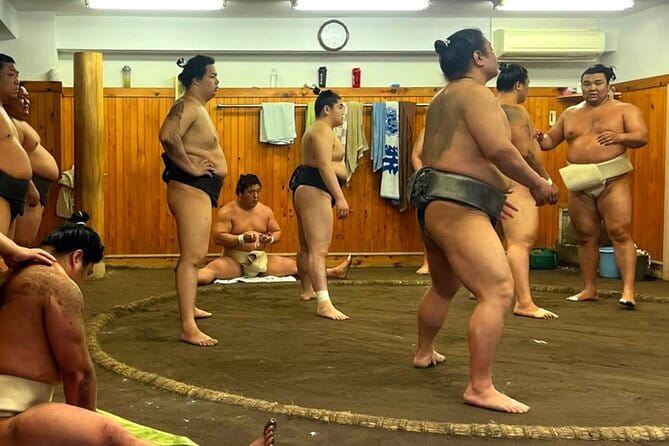
- Real sumo practice comes first: Watch from a respectful distance while wrestlers train, with no interruptions or posed performance.
- Five very different Tokyo stops: The route covers Arashio Beya, Tsukiji Outer Market, Hama Rikyu Gardens, Zojoji Temple, and Tokyo Tower.
- Tea and sutra copying are included: Garden admission, a tea house experience, and the temple sutra copying fee are part of the price.
- Food is extra: Tsukiji gives you time to sample and shop, but food and drinks are not included.
- The day uses trains and your feet: Only the train from Ningyocho Station to Tsukiji Station is included.
- Sumo is not guaranteed: Training may be canceled on some days, and practice closes during tournament periods in January, May, and September.
A rare look at sumo before the city wakes up
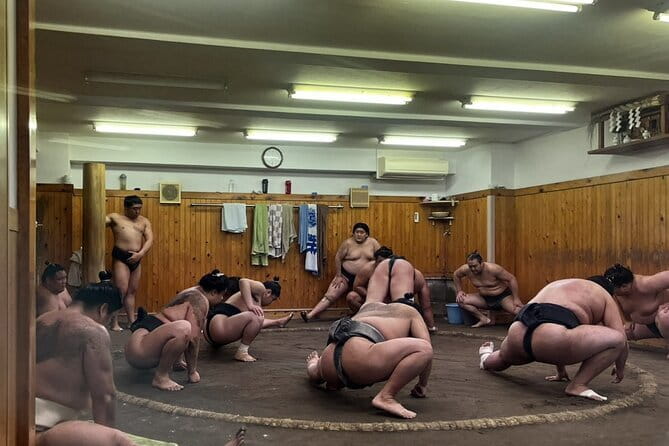
The morning begins at Hamacho Station at 8:15 am. From there, you head to Arashio Beya, a traditional sumo training room, for about 1 hour and 10 minutes.
This is the strongest reason to book the tour. You are not watching a demonstration arranged for tourists. The wrestlers are carrying out their regular training, and you must remain quiet and avoid disturbing them. That restraint is part of the experience. The appeal comes from seeing a serious Japanese tradition at close range, in an ordinary working setting.
Your guide can explain what you are seeing and help you understand the proper behavior. The supplied feedback singles out Jade for blending personal anecdotes with Japanese history, which is exactly the sort of guidance that can make a silent training session easier to appreciate.
There is an important condition. Sumo training is subject to change, so you may arrive on a day when no wrestlers are practicing. Training also closes during certain weeks when the Grand Sumo Tournaments take place in January, May, and September. If seeing sumo is your main reason for booking, confirm the schedule before paying and keep your expectations flexible.
Do not expect a private room, a photo opportunity with wrestlers, or a performance built around your visit. This is a watch-and-listen stop. For many people, that makes it more meaningful. For others, the uncertainty may make the $166.85 price harder to justify.
More Tea Experiences around Tokyo:
- Matcha Making Class in Tokyo with Authentic Japanese Sweets Set
★ 5.0 · 744 reviews - Kimono Tea Ceremony at Tokyo, Asakusa Maikoya
★ 5.0 · 638 reviews - Tokyo: Traditional Tea Ceremony with a Tea Master
★ 5.0 · 528 reviews
Tsukiji Outer Market: eat, browse, and choose your own extras
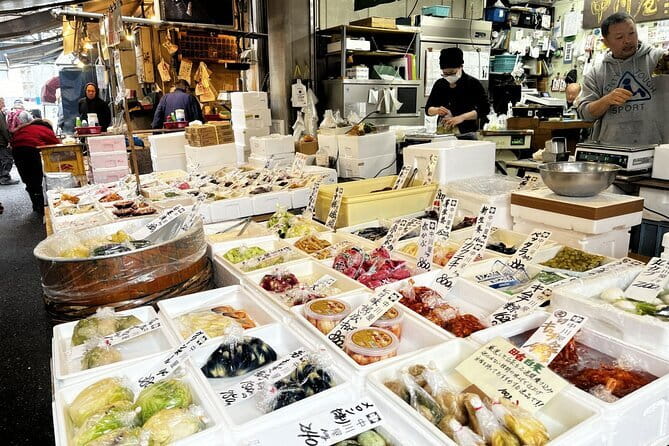
The next major stop is Tsukiji Outer Market, with about 1 hour and 30 minutes set aside. Your guide takes you through the market and points out food options, then you have time to explore, take pictures, and shop at your own pace.
This part gives the tour a useful change of rhythm. After the quiet concentration of sumo, Tsukiji is about looking, tasting, and making choices. The route is designed to let you sample the food on offer, but food and drinks are not included in the tour price. Bring a budget for anything you want to eat or buy.
That arrangement has a benefit. You are not locked into a fixed meal or forced to pay for food you do not want. If you have strong preferences, you can choose your own snacks. The drawback is that the advertised food experience can cost more than the listed tour price, depending on how much you purchase.
Use this stop wisely. You may want to eat lightly rather than fill up, since tea and a traditional sweet come later at Hama Rikyu Gardens. The 90-minute stop is also your best chance to browse at a relaxed pace, but it is not unlimited free time. Stay aware of the meeting instructions so you do not turn a market visit into a frantic search for the group.
Hama Rikyu Gardens and tea in a traditional setting
Hama Rikyu Gardens receives about 1 hour and 20 minutes. Admission is included, and the guide gives you an introduction to the garden and its past before allowing some free time.
The garden adds breathing room to the day. Tokyo can feel dense and fast, while a traditional garden asks you to slow down and notice carefully arranged views, open paths, and quiet spaces. You do not need to be a garden specialist to enjoy the contrast.
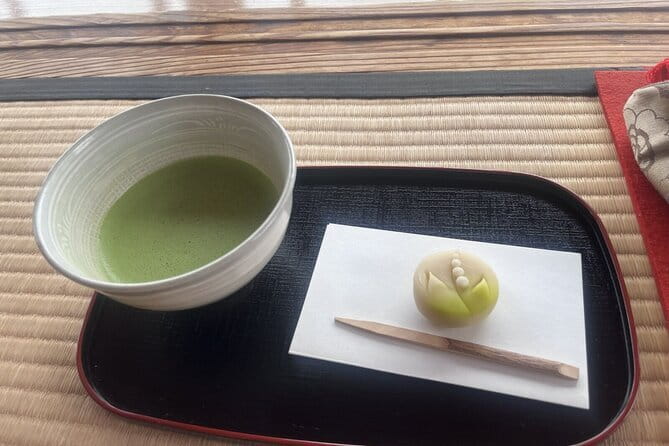
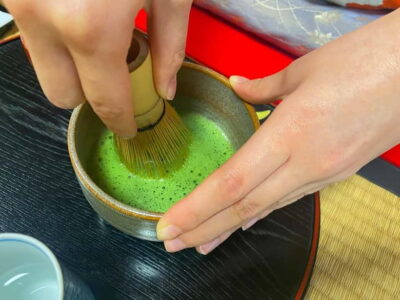
The included tea house experience is one of the tour’s better value points. You meet back with the group for traditional tea and a sweet in the garden. Since the tea experience and garden admission are already covered, you are not paying separately for one of the day’s most distinctly Japanese activities.
I would treat this as a cultural introduction rather than a formal tea ceremony course. The information provided promises tea and a sweet experience, not a lengthy lesson or a private ceremony. Still, it gives the day a calm center and helps balance the more active market and city stops.
The outdoor setting matters. Wear shoes and clothing that are comfortable for walking, and be ready for changing weather. This is an eight-hour day with several stops outside, not a sequence of indoor attractions connected by a private vehicle.
Zojoji Temple brings a quieter hour

The tour then visits Zojoji Temple for about one hour. Your guide explains the temple and its history, and the group takes part in a sutra copying experience.
This is a thoughtful inclusion. The activity gives you something to do rather than simply asking you to look at a building and move on. Copying a sutra can provide a quiet pause in the middle of a busy sightseeing day, and the fee is included.
You do not need to be religious to find value here. The experience offers a moment of concentration and calm after the market and before the final city view. If you prefer fast sightseeing, however, an hour devoted to temple explanation and copying may feel slower than expected.
The stop also adds an important layer to the route. Sumo, food, gardens, tea, and a Buddhist temple are not interchangeable attractions. Together, they give you several ways to encounter Tokyo: through sport, daily commerce, design, ritual, and urban views.
Same leaf, a different ritual:
- Dynamic Tokyo: Tokyo Tower, Tea Experience, Bay Cruise Day Tour
★ 4.5 · 521 reviews - Tokyo: Matcha Making Experience with Mochi Sweets in Asakusa
★ 4.9 · 388 reviews - Asakusa Cultural Walk & Matcha Making Tour
★ 5.0 · 245 reviews - Mt. Fuji & Lake Kawaguchiko Ropeway Panorama Full-Day Tour
★ 4.6 · 236 reviews
Tokyo Tower ends the day above the city
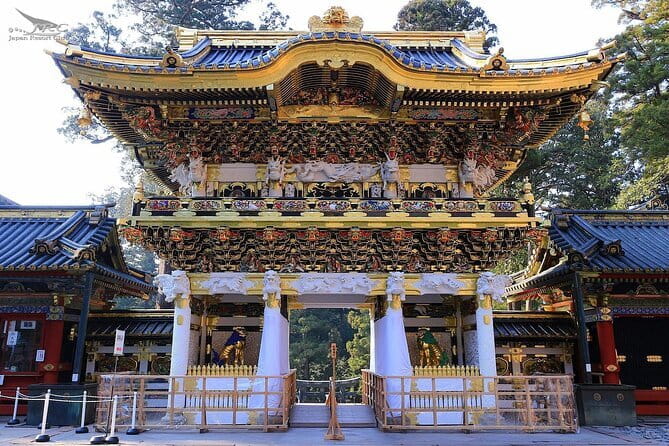
The final stop is Tokyo Tower, with about 1 hour and 15 minutes available. Your ticket is included, so you can go up to one of Tokyo’s well-known observation decks and look across the city.
Ending here works well. The earlier stops are close and personal, while Tokyo Tower gives you distance and scale. After walking through a market, garden, and temple complex, you can look back at the city from above and see how much ground the day has covered.
The tour also calls attention to the tower’s retro architectural feel. That makes the visit more than a quick photo stop. You have time to take in the structure and the views before the group finishes near Akabanebashi Station.
The final timing is useful for your onward plans. The tour ends at or near Akabanebashi Station, and the guide can help with questions about getting back to your hotel or reaching your next destination. Your return transport is not included, so allow for that extra cost.
What the $166.85 price really covers
At $166.85 per person, this is not a cheap walk. The price makes more sense when you separate the included items from the costs you must handle yourself.
Included are the English-speaking local guide, admission to Hama Rikyu Gardens, the tea house experience, the sutra copying fee, the Tokyo Tower ticket, and the train fare from Ningyocho Station to Tsukiji Station. Those admissions add real value, especially the tower and tea experience.
Not included are food, drinks, and transport before and after the tour. The tour does not use a private vehicle, and only the specified train journey is covered. You should budget for market purchases and your other train fares.
The group can have up to 15 people. That is small enough to feel more organized than a large bus outing, though it is not a private tour. A smaller group also matters at the temple, tea house, and transport connections, where staying together can save time.
The tour is commonly booked about 81 days ahead. That suggests you should reserve early if your Tokyo dates are fixed, especially if you want to try for a day when sumo training is scheduled. The free cancellation policy allows a full refund if you cancel at least 24 hours before the start time. Changes or cancellations inside that window are not accepted.
The walking and transport commitment

The day lasts approximately 8 hours and 15 minutes. Several hours are spent walking outdoors, with public transport connecting parts of the route.
That format suits you if you like seeing a city at street level. You will not spend the day sealed inside a coach, watching Tokyo through a window. You will move through stations, markets, gardens, temple grounds, and city streets.
The tradeoff is physical effort. Most people can participate, but the length and outdoor walking still deserve attention. Comfortable footwear is more important here than dressing for a polished city tour. Carry only what you want to manage for a full day.
The meeting point is Hamacho Station, at 2-chōme-59-3 Nihonbashihamachō, Chuo City. The tour starts at 8:15 am, so check your route to the station in advance. The finish is near Akabanebashi Station in Minato City, not back at the starting point.
This one-way design is efficient for sightseeing, but it means you should not plan to return to your hotel between stops. If you have evening reservations, leave enough time after the stated finish for the ride across Tokyo.
Who will get the most from this Tokyo day
I would recommend this tour to a first-time Tokyo visitor who wants several cultural experiences in one organized day. It is especially useful if you want help with context, public transport, and the small rules that matter at a sumo training room, temple, and tea house.
It also suits couples and small groups who prefer a full day with variety. Jade’s reported use of personal anecdotes and Japanese history suggests the guiding style can add a human touch rather than delivering only dates and facts.
You may want another option if your main goal is a guaranteed sumo event, a leisurely food tour, or private transport. Sumo is not certain, food costs extra, and the public-transport format requires you to walk and keep to the group’s timing.
The tour is also less suitable if you want to spend a long time at one attraction. Each stop has a clear time allowance, and the day is built around contrast. You get a sample of several sides of Tokyo rather than a slow study of one neighborhood.
Should you book it?
Book this tour if you want one well-planned day that joins traditional culture, local food, green space, religious practice, and a major city view. The combination is unusual, and the included tea, sutra copying, garden admission, and Tokyo Tower ticket make the price easier to understand.
Book with caution if seeing sumo is non-negotiable. The training schedule can change, and the wrestlers may not be practicing. Also remember that the $166.85 price does not cover market food, drinks, or most of your transport.
For the right person, this is a strong introduction to Tokyo because it does not rely only on headline sights. You get a working sumo room, an active market, a garden pause, a temple activity, and a final view from above. Just come ready to walk, spend a little extra at Tsukiji, and accept that the first stop may not unfold exactly as planned.
FAQ
Where does the tour start?
The tour starts at Hamacho Station, at 2-chōme-59-3 Nihonbashihamachō, Chuo City, Tokyo 103-0007, Japan.
What time does the tour begin?
The start time is 8:15 am.
Where does the tour finish?
The tour concludes near Akabanebashi Station in Minato City. The guide can assist with questions about transport to your hotel or next destination.
How long does the experience last?
The tour lasts approximately 8 hours and 15 minutes.
Is transportation included?
The train fee from Ningyocho Station to Tsukiji Station is included. Transport before and after the tour is not included, and the tour uses public transportation rather than a private vehicle.
Is food included?
No. Food and drinks are not included, so you pay separately for anything you choose to eat or buy at Tsukiji Outer Market.
Is sumo training guaranteed?
No. The training schedule can change, and there may be days when no sumo training takes place. Training is also closed during certain weeks when Grand Sumo Tournaments are held in January, May, and September.
What is included in the ticket price?
The price includes an English-speaking local guide, Hama Rikyu Gardens admission, the garden tea house experience, the sutra copying experience fee, the Tokyo Tower ticket, and the train fee from Ningyocho Station to Tsukiji Station.
Newly steeped around Tokyo
- Yokohama : Tea Ceremony with Sweets and Souvenir★ 5.0 · 5 reviews
- Walking Tour: Yanaka,Nezu& Sendagi: Tea Ceremony & Old Tokyo★ 5.0 · 3 reviews
- Private Mochi・Matcha sweets Making Class Near Shibuya Area★ 5.0 · 22 reviews
- 2 Hours Mochi &Nerikiri Making & Matcha Class in Bunkyo★ 5.0 · 21 reviews
- Private Kimono and tea ceremony at local home near Tokyo Disney★ 5.0 · 6 reviews
- Kimono and Tea Ceremony in Asakusa Private Food Tour With Guide★ 5.0 · 4 reviews
- Giant Sushi Cooking Class: Make a 1.5m Sushi Roll in Tokyo★ 5.0 · 9 reviews
- Tokyo Tea Ceremony Class at a Traditional Tea Room★ 5.0 · 2 reviews
Japan Tea Tours, compared.
Kyoto: Tea Ceremony in a Traditional Tea House in Kiyomizu
Read our review →
Kyoto: 45-Minute Tea Ceremony Lesson Experience
Read our review →
World Heritage Kyoto & Nara Uji Authentic Matcha Experience
Read our review →
Kyoto: Table-Style Tea Ceremony at a Kyo-Machiya
Read our review →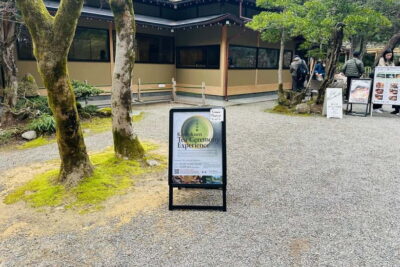

Browse the lists this tea experience appears in