
Review · HIROSHIMA
Hiroshima: Kimono, Koto, and Simple Tea Ceremony Experience
The most memorable part of this Hiroshima experience is its personal setting. You are not being marched through a large cultural center. You are welcomed into Kazuko Mensing’s Japanese-style home, dressed in kimono, and given time to try several small traditions at an easy pace. Her 40 years of koto study and her lifelong connection to Hiroshima give the visit unusual depth.
I especially like the chance to combine hands-on activities with conversation. Playing the koto, sipping matcha, folding paper cranes, or trying children’s igo can make Japanese culture feel less distant. I also like the private-group format and the warm, family-friendly approach described by Kazuko’s previous customers. The main drawback is that 90 minutes goes quickly, and you must be able to climb stairs. Wheelchair users cannot take part.
Key points to know before you book
- Kazuko Mensing leads the visit: She speaks English and Japanese, has lived in Hiroshima all her life, and has studied koto for 40 years.
- You choose from several activities: Kimono dressing, koto playing, a simple tea ceremony, igo, shougi, origami, calligraphy, and photo props may all fit into the visit, though time is limited.
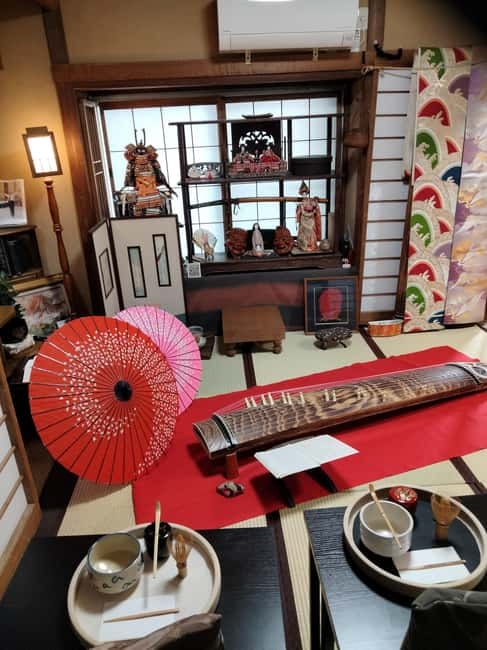
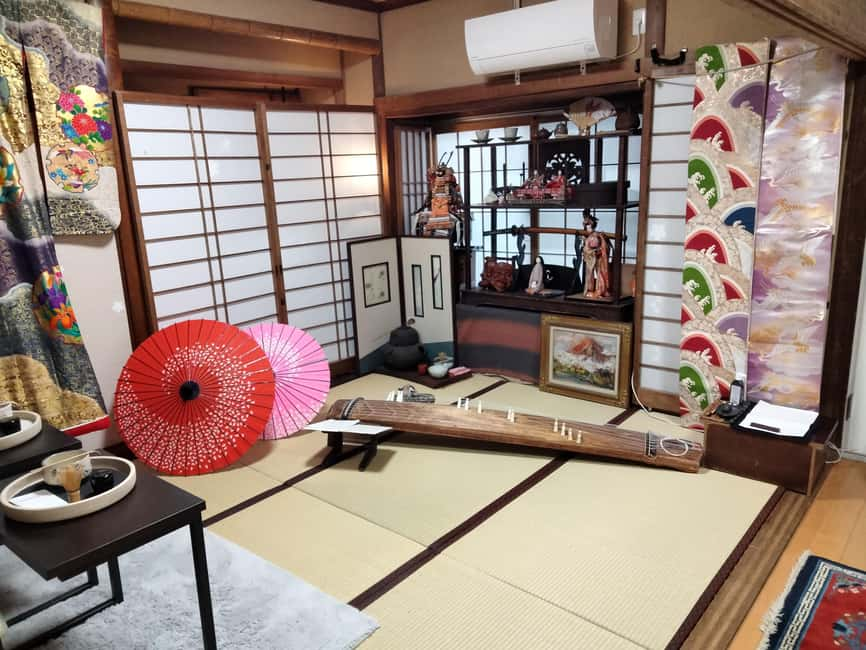
- The setting is a real Japanese-style home: Masks, statues, and traditional decorations provide a more personal backdrop than a standard studio.
- The experience is close to central Hiroshima: The home is about a 15-minute walk from the Atomic Bomb Dome.
- It works well for families: A child-friendly version of igo and hands-on activities can keep younger visitors involved.
- Stairs are required: The activity is disability-friendly in spirit, but it is not suitable for wheelchair users.
A small Hiroshima home with a big personal story
This experience begins outside the FamilyMart beside Toukaichi Station. Look for Kazuko wearing a short black kimono jacket. The meeting point is practical, since it gives you a clear landmark and avoids the confusion that can come with finding a private home in an unfamiliar city.
From there, you head to the Japanese-style house where the activity takes place. Expect a relaxed setting decorated with cultural masks, statues, and other traditional objects. This is not a formal museum display, so you can ask questions and look around in a more natural way.
Kazuko is a second-generation atomic bomb survivor and has spent her whole life in Hiroshima. That does not turn the activity into a full peace-tour lecture, but it adds a meaningful human connection to a city often introduced through statistics and memorials. If you want to ask about Hiroshima’s past, the setting may make that conversation easier than a crowded sightseeing stop.
The visit is conducted in English and Japanese. English-speaking visitors have a clear advantage here, since Kazuko can explain the activities directly rather than relying on gestures or a translation app. Her friendly manner also matters for families. A child who feels shy at first can take part without needing to perform in front of a large group.
More Kimono and Tea Ceremonies in Japan:
- Kimono Tea Ceremony at Kyoto Maikoya, NISHIKI
★ 5.0 · 911 reviews - Kimono Tea Ceremony at Tokyo, Asakusa Maikoya
★ 5.0 · 638 reviews - Kyoto: Kimono Tea Ceremony at Orizuruya Gion
★ 4.9 · 618 reviews
Kimono dressing is more than a photo stop
The kimono portion gives you the first clear change of pace. You select traditional clothing, with options for both men and women, and Kazuko helps you dress. The point is not simply to put on an attractive costume for a few minutes. Wearing a kimono changes how you sit, walk, and move your arms, which gives you a small sense of the care built into Japanese dress.
You will likely want photos, and the house provides a fitting background. You can pose holding a Japanese katana or umbrella, using the objects as photo props while dressed in kimono. These are playful images, but they also help the clothing feel connected to traditional Japanese life instead of being just a rented outfit.
The time limit is worth keeping in mind. Dressing can take a fair share of a 90-minute visit, especially if several people are participating. If you want the koto, tea, games, and other activities too, tell Kazuko what matters most at the start. A private format gives you some flexibility, but no short experience can do everything in depth.
For families, the clothing can be a strong hook. Children may not be ready to discuss Japanese history for an hour, but they may happily try on kimono, pose with an umbrella, and then move to an instrument or game. The activity works best when you treat the clothing as the beginning of the visit, not its entire purpose.
The koto gives the experience its strongest cultural focus
The koto is the most distinctive part of this activity. It is a traditional Japanese stringed instrument, and Kazuko has studied it for 40 years. That long background means you are not simply handed an instrument and left to make random sounds. You can expect an introduction to how it is played and a chance to try it yourself.
Koto playing is especially valuable because it is physical and immediate. You feel the strings, notice the instrument’s shape, and begin to understand the control needed to produce a clean sound. Even a short lesson can give you more respect for the music than listening to a performance from a distance.
You may also be able to play together with Kazuko or another member of your private group. The available details indicate that shared playing can be part of the visit, though the exact amount depends on the group and the time. Ask early if the koto is your top priority.
I would place the koto near the top of your list, especially if you have already spent time visiting Hiroshima’s main memorial sites. It offers a calm contrast to the city’s heavier historical subjects. The only caution is that it is an introduction, not a full music lesson. You will get a taste of the instrument rather than a detailed course in technique or musical history.
A simple tea ceremony without the formal pressure
The tea portion is described as a simple tea ceremony. That wording is useful. You should expect an introduction to the meaning and basic customs of tea, along with matcha, rather than a long formal ceremony with strict ritual at every stage.
This format suits first-time visitors. You can learn why the preparation and serving of tea matter in Japanese culture without worrying that you will make a serious mistake. The atmosphere is intended to be welcoming, and Kazuko can explain what you are doing in English.
The tea ceremony also gives the visit a quieter center. After dressing and trying the koto, sitting down with matcha slows things down. You pay attention to the bowl, the gestures, and the act of sharing tea. These details can be easy to miss when you encounter tea culture only as a packaged demonstration.
Matcha has a strong flavor that not everyone enjoys, so do not book this solely for a sweet drink. The value is in the explanation and the setting. If you dislike matcha, you can still get plenty from the ceremony’s cultural side, but the experience does not promise an alternate beverage.
More Tea Ceremonies in Japan:
- Kyoto: Tea Ceremony in a Traditional Tea House in Kiyomizu
★ 4.9 · 3,519 reviews - Kyoto: Tea Ceremony Ju-An at Jotokuji Temple
★ 4.9 · 3,207 reviews - Kyoto: 45-Minute Tea Ceremony Lesson Experience
★ 4.3 · 2,378 reviews - Osaka: Tea Ceremony Experience
★ 4.9 · 1,426 reviews
Igo, shougi, origami, and calligraphy add choice
The activity includes traditional Japanese board games, including igo and shougi. Igo is known internationally as go, while shougi is often described as Japanese chess. Both games can become complicated, but you are not expected to master them during a short cultural visit.
For younger participants, a children’s version of igo may be available. This is a useful detail for parents. A child can understand the basic idea and enjoy placing pieces without facing the full complexity of the adult game. If you are visiting with children, ask Kazuko to begin with the simplest version.
Shougi may appeal more to visitors who enjoy strategy games, but the same time limit applies. You will probably learn the basic idea rather than play a complete serious match. These games are best seen as a doorway into everyday Japanese culture, where traditional games can be social activities rather than museum objects.
Additional hands-on activities may include folding origami cranes and writing Japanese characters. These were part of one family’s visit and show how Kazuko can adapt the session to children and personal interests. The paper cranes have a special connection to Hiroshima, and some visitors may choose to leave them at the memorial connected with Sadako Sasaki.
Do not assume you will complete every activity listed. The price includes a broad menu, but the visit lasts only 90 minutes. Tell Kazuko before or at the beginning whether you prefer music, tea, games, crafts, or photos. That small bit of planning will help you get better value.
Why the private format changes the experience
This is a private-group activity, not a large class. That affects both the mood and the practical value. You can ask direct questions, take your time with an unfamiliar activity, and adjust the balance between dressing, music, tea, and games.
A private setting is also helpful if you are traveling with a child or with someone who is nervous about cultural etiquette. You can make mistakes without an audience. Kazuko can spend more time explaining a point or changing the activity when one option is not holding your attention.
There is a trade-off. In a large group, you might watch several other people experience the same activity, which can make a demonstration feel livelier. Here, the strength is personal attention rather than scale. You are paying for access to a host, a home setting, and several guided encounters, not for a lengthy performance.
The price is $76 per person. I consider that reasonable if you take part in several elements and value the private format. Kimono dressing, a koto introduction, tea, games, and conversation would each be modest experiences on their own. Together, they create a fuller cultural visit, though the short duration means you should not expect expert instruction in every subject.
A good stop before or after the Atomic Bomb Dome
The home is about a 15-minute walk from the Atomic Bomb Dome. That makes it easy to pair with Hiroshima’s central peace sites, though you should leave enough time to arrive at the meeting point outside FamilyMart beside Toukaichi Station.
The contrast between the two parts of your day can be useful. The Atomic Bomb Dome and nearby memorial sites call for quiet attention to Hiroshima’s wartime past. Kazuko’s home offers a more intimate look at music, clothing, games, tea, and family life. One does not replace the other.
If you are planning a full day around the Peace Memorial Park, consider placing this activity before or after your memorial visit rather than squeezing it into a rushed gap. The kimono dressing and conversation may take longer than expected, and you will enjoy the home more if you are not watching the clock for your next appointment.
The central location also helps if the weather is poor. Much of the visit takes place indoors, although the walk from the station and later sightseeing still require outdoor time.
Who will enjoy this most
I would recommend this for visitors who want contact with Japanese culture but do not want a highly formal class. It is especially suitable for:
- Families with children who need several kinds of activities
- First-time visitors curious about kimono and matcha
- Music lovers interested in trying a traditional instrument
- Couples or small private groups who prefer conversation over a scripted show
- Visitors staying near central Hiroshima
- LGBTQ travelers looking for an explicitly welcoming activity
It is less suitable if you want a full tea ceremony, a serious koto lesson, or an in-depth course in igo or shougi. The range is broad, but the session is short. You will get a sample of several traditions, not mastery of one.
Accessibility also needs a clear note. The activity is described as disability-friendly, but you must be able to go upstairs. It is not suitable for wheelchair users. Ask about any other mobility concerns before booking, since the available information only confirms the stair requirement.
Practical details that matter on the day
The experience lasts 90 minutes, and start times vary, so check availability for the day you want. Meet outside the FamilyMart right by Toukaichi Station and look for Kazuko’s short black kimono jacket.
Wear something that makes changing clothes manageable. The exact dressing arrangements are not specified, so avoid building a tight schedule around the activity. You may also want to keep your phone ready for photos, since the kimono, umbrella, katana, home decorations, and koto all provide natural subjects.
You can cancel up to 24 hours ahead for a full refund, and the reserve-now, pay-later option allows you to hold a place without paying at once. Those policies are useful if your Hiroshima schedule is still shifting.
Should you book it?
Book this experience if you want a personal and flexible introduction to Japanese culture near Hiroshima’s main memorial area. Kazuko’s English, lifelong connection to the city, 40 years with the koto, and welcoming approach make the visit more than a costume photo session.
I would book it particularly for a family, a first-time Japan visitor, or anyone who wants to talk with a local host in a home setting. Go in with realistic expectations: you will sample many traditions, not study one at length. If you can accept that trade-off, $76 buys a friendly, hands-on hour and a half that can add warmth and human scale to your Hiroshima itinerary.
FAQ
How long does the Hiroshima kimono and tea experience last?
The experience lasts 90 minutes.
Where is the meeting point?
Meet outside the FamilyMart beside Toukaichi Station. Your guide, Kazuko Mensing, will be wearing a short black kimono jacket.
Is the activity offered in English?
Yes. The experience is conducted in English and Japanese, and Kazuko speaks English fluently.
What activities are included?
The experience includes kimono dressing, koto playing, a simple tea ceremony, katana and umbrella holding, and time to relax in a Japanese-style home. Igo, shougi, origami, and Japanese calligraphy may also be available depending on the time and group.
Is the experience suitable for wheelchair users?
No. The activity requires participants to go upstairs and is not suitable for wheelchair users.
Can I cancel the booking?
Yes. You can cancel up to 24 hours in advance for a full refund. You can also reserve now and pay later.
Newly steeped around Japan
- Yokohama : Tea Ceremony with Sweets and Souvenir★ 5.0 · 5 reviews
- Whisk Your Own Matcha: A Zen Matcha Experience at Temple★ 3.6 · 7 reviews
- Walking Tour: Yanaka,Nezu& Sendagi: Tea Ceremony & Old Tokyo★ 5.0 · 3 reviews
- Visit local home for music and tea ceremony near Disney★ 4.9 · 13 reviews
- Trip to Kamakura & Enoshima: Shrines, Seaside, Temples &Tea★ 5.0 · 11 reviews
- Yokohama: Sushi & Gyoza Cooking with Matcha & GreenTea Experience★ 5.0 · 3 reviews
- Kyoto tea town for matcha lovers★ 5.0 · 16 reviews
- Uji: Private immersion into Kyoto’s tea and reglious culture★ 5.0 · 17 reviews
Kimono & Tea Ceremony, compared.

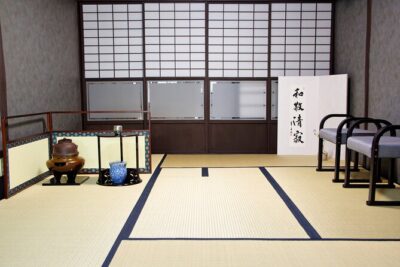
KYOTO Tea Ceremony with kimono near by Imamiya Jinjya Shrine
Read our review →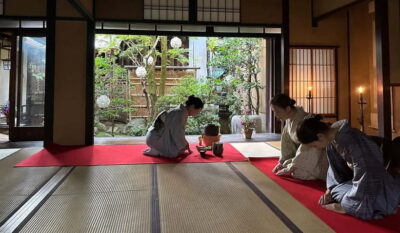
Kyoto: Kimono and Tea Ceremony Experience at Cultural Asset
Read our review →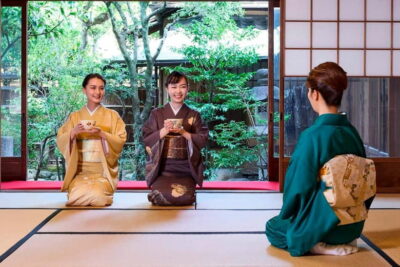
Kyoto: Kimono Tea Ceremony with Matcha and Sweet
Read our review →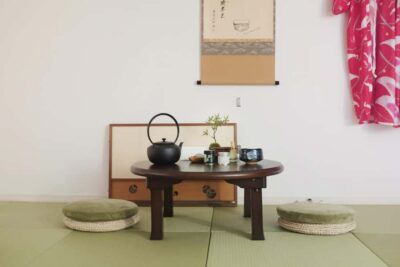
Tokyo: Asakusa Kimono Dressing and Matcha Experience
Read our review →Browse the lists this tea experience appears in