Review · OSAKA
Premium Kimono Dressing, Tea Ceremony, Calligraphy, Samurai show
The most memorable part of this Osaka experience is the chance to take part, not simply watch. You can be dressed in a kimono, practice calligraphy, prepare matcha, and see traditional music and samurai sword performances at -michi-, based at Shinsaibashi ARTY Inn. Hands-on cultural lessons make the visit feel personal.
I like the careful kimono dressing, where each step is explained, and the calligraphy session, which gives you something more lasting than a few photos. I also like the warm, attentive teaching style and the chance to pose in a serene courtyard and historical gallery. You leave with a better sense of what these traditions mean, not just what they look like.
The main catch is the price, $123.49 per person, especially if you also want armor dressing or the ¥10,000 souvenir. Kimono dressing is listed for women only, and the experience packs several activities into roughly three hours, so anyone wanting a slow, highly private lesson should check the pace before booking.
Key points to know before booking
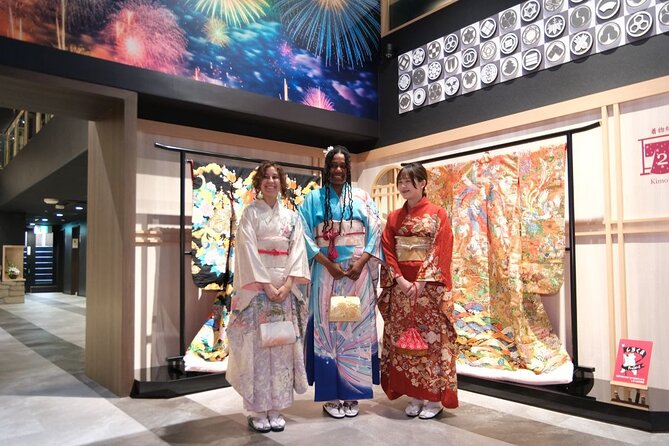
- Kimono dressing is for women: The outfit is carefully arranged, with explanations of the dressing process and its meaning.
- Tea ceremony and calligraphy are hands-on: You prepare matcha and make your own calligraphy rather than only watching a demonstration.
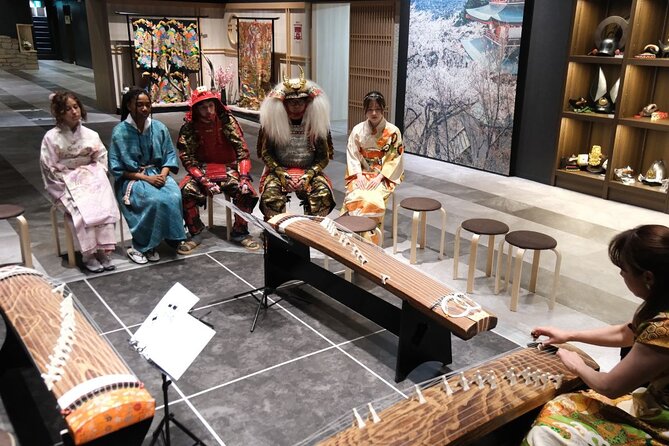
- Samurai elements add visual drama: Armor dressing is available as an additional cost, and a live sword performance is part of the cultural program.
- Traditional music is included: The session combines several Japanese arts instead of focusing on one short activity.
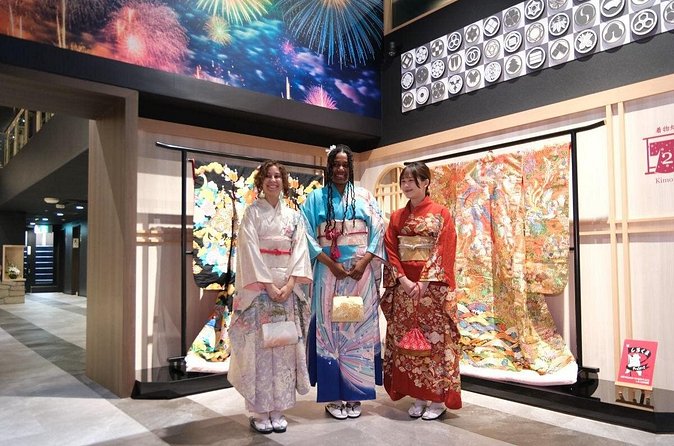
- The setting helps with photographs: You can use the courtyard and historical gallery as backdrops while wearing your chosen costume.
- The experience takes about three hours: It works well as a planned half-day stop in central Osaka, near public transportation.
A three-hour introduction to Japanese arts
At -michi-, the appeal is variety. In one visit, you move between clothing, tea, writing, music, and samurai performance. That makes this a useful choice if you want a clear introduction to several Japanese traditions but do not have time to arrange separate workshops.
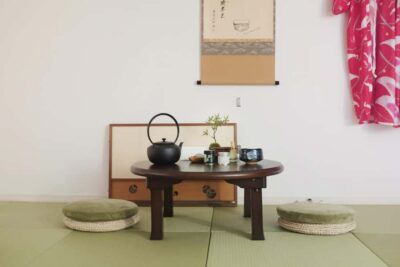
The experience takes place at Shinsaibashi ARTY Inn in Osaka. The setting includes a courtyard and a historical gallery, giving the program more atmosphere than a plain classroom. You can take photographs during the visit, but the photos work best as a record of activities you have actually tried.
The program is designed for participation. Staff explain what you are doing and why, which matters when a ritual has unfamiliar steps. Instead of guessing how to hold a brush or approach a tea ceremony, you receive direction as you go.
More Tea and Calligraphy Workshops in Japan
- Osaka: Tea Ceremony, Calligraphy, and Kimono Experience
★ 4.9 · 130 reviews - Osaka: Private Tea Ceremony and Calligraphy Experience
★ 5.0 · 50 reviews - Samurai dress-up and shows, plus Tea Ceremony & Calligraphy
★ 5.0 · 27 reviews
Kimono dressing, with time to understand the details
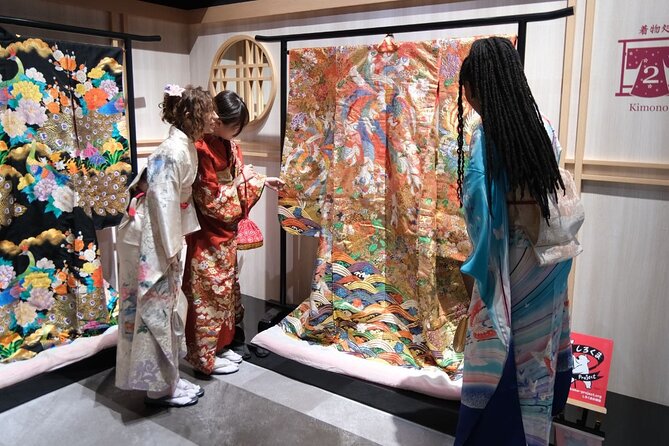
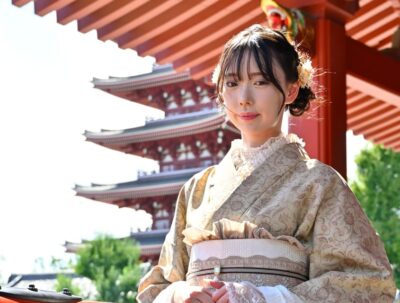
For women, kimono dressing is one of the central activities. The clothing is not simply handed to you for a quick costume photograph. The dressing process includes an explanation of the various steps, so you get a basic sense of how the garment is arranged and why the finished look requires care.
That attention is important. A kimono can appear simple in a photograph, but the effect depends on how the layers, belt, and accessories are placed. The staff’s explanations help turn dressing into a cultural lesson rather than a change of clothes.
You should allow time to stand, pose, and enjoy the outfit. The courtyard and gallery provide useful settings for photos, and the kimono gives the rest of the visit a sense of occasion. Calligraphy and tea ceremony also feel different when you are dressed for them.
The limitation is clear: kimono dressing is specified for women only. If you are booking as a couple, family, or mixed group, confirm how the other participants will take part before you pay. Armor dressing may offer another option, but it is not included in the stated price.
Tea ceremony: a quiet change of pace
The tea ceremony gives the program a slower rhythm after the dressing session. You learn about matcha and take part in preparing your own tea. That small act matters because it puts you inside the process instead of leaving you as a spectator.
You should not expect a long specialist tea-school course in a three-hour cultural program. The value is the introduction: you learn the basic flow, see the care given to the preparation, and gain some context for an important Japanese custom.
I especially like this part for first-time visitors who want structure. Tea ceremony etiquette can seem mysterious when you encounter it without explanation. Here, staff guide you through the activity and explain the meaning behind what you are doing.
The setting also helps. Moving from the visual impact of kimono dressing to the measured tea activity gives the visit a useful balance. It is not all posing and performance. You get a quieter moment to pay attention.
Calligraphy you can take home
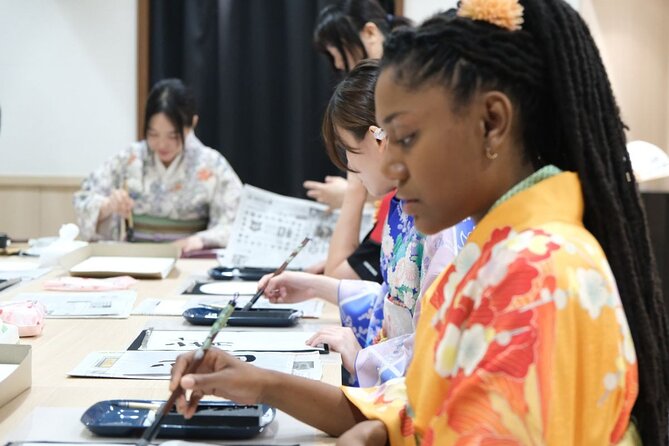
The calligraphy session is another strong part of the experience. You practice with guidance and produce your own work. Even if your first attempt is uneven, that is part of the charm. The finished piece can become a personal souvenir, and one participant planned to have the result framed.
Calligraphy gives you a direct connection to the physical side of Japanese writing. The brush, ink, paper, and controlled movements make the activity different from simply writing your name in a notebook. Staff explain the process, so you can focus on technique rather than worry about getting every stroke perfect.
I would treat this as a learning activity first and a photograph second. The best keepsake is not necessarily the neatest sheet. It is the piece that reminds you of the time spent learning how Japanese characters are formed.
Families and first-time visitors may find calligraphy especially rewarding because it creates a clear result. You can see what you made at the end, and the activity does not depend on already knowing Japanese.
More Tea and Calligraphy Workshops in Osaka
- Osaka: Tea Ceremony, Calligraphy, and Kimono Experience
★ 5.0 · 6 reviews - Tea and Calligraphy Session at a Table in Osaka
★ 5.0 · 4 reviews - Osaka: Castle, Tea Ceremony, Calligraphy, and Samurai Armor!
★ 5.0 · 4 reviews
Music and the samurai performance
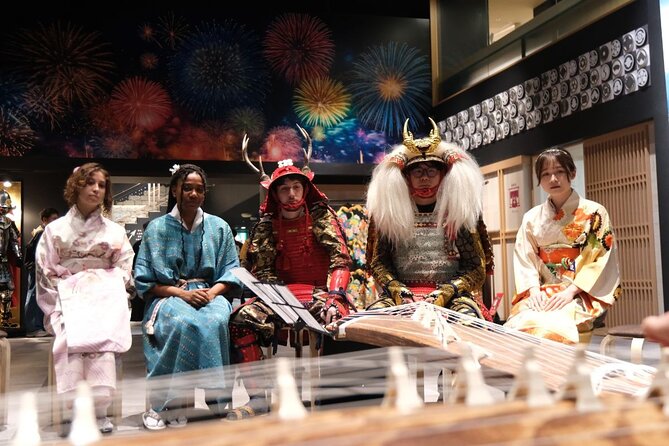
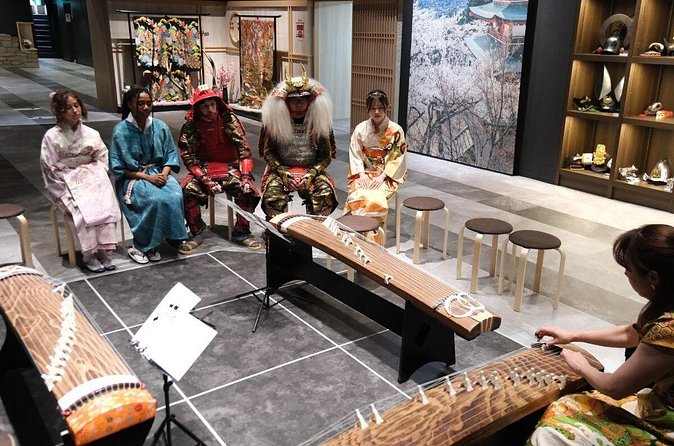
Traditional Japanese music forms part of the program, adding sound to the clothing, tea, and writing activities. This matters because cultural demonstrations can feel flat when they rely only on visual displays. Music gives the visit another way to understand the mood and style of the traditions being presented.
The samurai portion brings more action. You can watch a samurai sword performance, and the program is also described as allowing participation in traditional music and samurai sword performances. Expect a staged cultural presentation rather than a combat lesson unless the staff explain otherwise on the day.
Armor dressing is a separate consideration. The experience description highlights the chance to try real armor, but the included list does not include armor dressing. The additional cost is not specified in the supplied details, so confirm the current price before booking. A ¥10,000 souvenir is also listed as an extra, at the same price per person.
This is where the total cost can rise. At $123.49, the base experience already covers several activities. Add-ons may make sense if armor is your main reason for coming, but you should compare the final amount with your priorities. If you mainly want tea and calligraphy, the included program may be enough.
What the staff add to the experience
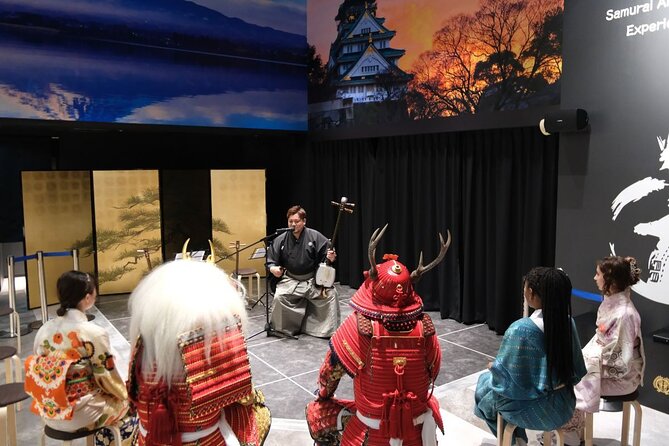
The staff are a major part of the appeal. They are described as warm, helpful, welcoming, and attentive, with a strong focus on explaining each event and its meaning. That style suits an activity like this, since the customs are often more rewarding when someone gives you context.
You can expect the staff to guide you through the kimono dressing, tea ceremony, and calligraphy. Their explanations also help connect the separate activities. Without that link, the program could feel like a sequence of unrelated demonstrations. With it, you begin to see how clothing, manners, writing, music, and samurai culture all present different sides of Japan.
No individual guide names are provided, so I would not book this expecting a particular host. The useful point is the teaching approach. The staff are there to help you take part, answer questions, and understand what you are doing.
The boutique-like scale is another plus. The experience is presented as attentive and personal rather than as a large commercial show. Still, the supplied information does not state the maximum group size, so do not assume a private lesson unless that is confirmed during booking.
Is $123.49 good value?
The price is not low for a three-hour activity. You can find less expensive ways to rent a kimono, attend a cultural show, or try a short calligraphy lesson in Japan. The question is what you want from your Osaka visit.
Here, the fee covers several connected activities: women’s kimono dressing, tea ceremony, calligraphy, and traditional music. The program also includes a samurai sword performance, plus access to a setting suited to photographs. If you paid separately for each element, planning could take more time and the day could feel less joined-up.
I see the best value for someone who wants a guided first look at Japanese culture. You receive explanations, equipment, costume dressing, and several activities in one booking. That convenience has real value, especially if you have only a few days in Osaka.
The value is weaker if you want only one specialist activity. A person focused entirely on formal tea ceremony may prefer a dedicated tea lesson. Someone mainly interested in samurai armor should calculate the add-on cost first. Families should also check how the women-only kimono option affects the whole group.
The experience is booked, on average, 42 days ahead. That suggests planning early is sensible, particularly if your Osaka dates are fixed. The mobile ticket makes entry simple, and confirmation is provided at booking.
Who should book this Osaka experience?
I would recommend it to first-time visitors who want cultural context without spending a full day at a museum. It suits couples, families, and small groups who enjoy trying things with their hands and taking photographs along the way.
It is also a good match for anyone who feels unsure about Japanese etiquette. The staff guide you through each step, so you do not need prior knowledge of tea ceremony, calligraphy, kimono, or samurai traditions.
You may want to skip it if you dislike costume activities, staged performances, or a schedule built around several short sections. The program has a lot to cover in three hours. It offers breadth rather than one long, specialized lesson.
If you are traveling with men or boys who want to wear a kimono, check the arrangement before booking because the included kimono dressing is for women only. If armor is the main attraction, ask about its availability and extra charge before you commit.
Practical details that affect your visit
The meeting point is Shinsaibashi ARTY Inn, and the location is near public transportation. That makes it easy to fit into a day around Shinsaibashi and central Osaka, though the supplied details do not give a precise station exit or walking time.
The activity lasts approximately three hours. Keep that block free rather than scheduling a museum, meal, or train connection too tightly afterward. Dressing, photographs, tea, calligraphy, music, and the samurai performance all need room in the schedule.
Most people can participate, according to the provided information. If you have a specific mobility or dressing concern, contact the provider before booking, since the details do not explain seating, changing arrangements, or step-free access.
Free cancellation is available if you cancel at least 24 hours before the local start time. Cancellations or changes inside that window are not refunded or accepted. That policy gives you flexibility early on, but your plans need to be firm by the final day.
Should you book -michi-?
Book this experience if you want a friendly, well-organized introduction to several Japanese traditions in one place. The strongest reasons are the carefully explained kimono dressing, the hands-on tea and calligraphy sessions, and staff who make the activities understandable rather than merely decorative.
At $123.49, it is a meaningful splurge, not a casual drop-in activity. You should also budget separately if armor dressing or the ¥10,000 souvenir matters to you. For a focused tea student or a visitor seeking only a samurai show, another activity may offer better value.
For most first-time visitors with three hours to spare, I think the mix works. You get photographs, a calligraphy keepsake, a taste of matcha preparation, traditional music, and a samurai performance, all with explanations along the way. That is a practical way to add substance to your Osaka itinerary.
FAQ
Where does the experience take place?
The activity takes place at Shinsaibashi ARTY Inn in Osaka.
How long does the experience last?
It lasts approximately three hours.
What is included in the price?
The included activities are women’s kimono dressing, a tea ceremony, calligraphy, and a Japanese traditional music performance.
Is armor dressing included?
No. Armor dressing is not included in the stated inclusions. Confirm the current additional cost before booking.
Is a samurai performance part of the experience?
The program includes viewing and participating in traditional music and samurai sword performances.
Can I cancel for a full refund?
Yes. You can receive a full refund if you cancel at least 24 hours before the experience’s start time. Cancellations within 24 hours are not refunded.
Is the activity accessible by public transportation?
Yes. The experience is near public transportation, and most people can participate. Specific accessibility arrangements are not provided.
More Kimono and Tea Ceremonies in Osaka
- Sheraton Miyako Hotel Osaka: Tea Ceremony with Kimono Rental
★ 5.0 · 2 reviews - Kimono Tea Ceremony at Kyoto Maikoya, NISHIKI
★ 5.0 · 911 reviews - Kimono Tea Ceremony at Tokyo, Asakusa Maikoya
★ 5.0 · 638 reviews - Kyoto: Kimono Tea Ceremony at Orizuruya Gion
★ 4.9 · 618 reviews
More Tea Ceremonies in Osaka
- Osaka: Tea Ceremony Experience
★ 4.9 · 1,426 reviews - Tea Ceremony Experience in Osaka Doutonbori
★ 5.0 · 754 reviews - Osaka: Japanese Traditional Sweets Making and Tea Ceremony
★ 4.7 · 118 reviews - Samurai Show, Tea Ceremony, Japanese Traditional Activities
★ 5.0 · 56 reviews
Newly steeped around Osaka
- Osaka:Zen Tea Ceremony and Foot Bath Experience<45min>★ 5.0 · 7 reviews
- Osaka Japanese Cooking And Matcha Class near Osaka Castle★ 5.0 · 22 reviews
- Nara Deer Park, Uji Matcha, & Hot Spring Full-Day Tour from Osaka★ 4.0 · 21 reviews
- Osaka: Tea Ceremony, Calligraphy, and Kimono Experience★ 5.0 · 6 reviews
- Tea and Calligraphy Session at a Table in Osaka★ 5.0 · 4 reviews
- Osaka: Nara, Todaiji, Uji Matcha, and Hot Spring Tour★ 4.0 · 7 reviews
- Craft Sushi and Matcha Ice Cream in Central Osaka (3-Course Meal)★ 5.0 · 2 reviews
- ZEN therapy | Shiatsu-style massage, EnergyTherapy & Japanese Tea★ 5.0 · 5 reviews
Kimono & Tea Ceremony, compared.


KYOTO Tea Ceremony with kimono near by Imamiya Jinjya Shrine
Read our review →
Kyoto: Kimono and Tea Ceremony Experience at Cultural Asset
Read our review →
Kyoto: Kimono Tea Ceremony with Matcha and Sweet
Read our review →